
If you're new to the cello, or helping a student who is, one of the first things to learn is the name of each string. The four cello strings are C, G, D and A, listed from lowest to highest. In this guide, we cover each string's pitch, simple ways to remember the order, how cello strings compare to violin, viola and bass strings, what string names mean in sheet music, and how to choose and replace your strings.
The Four Cello Strings: Names, Order and Pitch
The four strings on a cello are C, G, D and A, from lowest to highest. Each string is tuned a perfect fifth above the one below it, which gives the cello its wide, even range from deep bass notes to singing upper tones.
| String | Note | Scientific pitch | Approximate frequency |
|---|---|---|---|
| 4th (lowest) | C | C2 | 65.4 Hz |
| 3rd | G | G2 | 98.0 Hz |
| 2nd | D | D3 | 146.8 Hz |
| 1st (highest) | A | A3 | 220 Hz |
These approximate frequencies use equal temperament with A4 = 440 Hz. Tuning pure fifths by ear produces slightly different values for C, G and D.
The low C string sits two octaves below middle C (C4). The A string is the highest open string and is normally the thinnest; its pitch, A3, is one octave below the A4 commonly used as a tuning reference.
Most cellists tune the A string first, then D, G and C. If your tuner is calibrated to A4 = 440 Hz, the cello's open A3 should read 220 Hz: do not tighten it up to A4. Ensembles may use a different reference pitch, so ask your teacher or group which calibration to use. Match both the note name and its octave.
How to Remember the Cello Strings
The easiest way to lock in the string names is with a short phrase. Here are two to try, depending on which direction you like to think in.
- Low to high (C, G, D, A): "Cats Go Down Alleys"
- High to low (A, D, G, C): "A Darn Good Cello"
Many students learn the low-to-high version first, since that matches the order of the table above. The high-to-low version is handy when tuning, because you usually start with the A string and work your way down.
A physical cue helps too: the A and C strings are at opposite edges of the fingerboard. A is normally the thinnest and highest, while C is normally the thickest and lowest. Identify them by pitch and string label rather than an unexplained left/right diagram, since a player's view and a front-facing view are different.
The open strings form successive perfect fifths: C to G, G to D, and D to A. Each interval spans five letter names when you count both ends, such as C, D, E, F, G. This is the same sequence of note names found along the circle of fifths.
Cello Strings vs Violin, Viola and Bass Strings
The cello shares its string names with the viola, but it sounds a full octave lower. Here's how the four members of the string family compare, listed from lowest string to highest.
| Instrument | Strings (low to high) | Tuning interval | Lowest note |
|---|---|---|---|
| Violin | G, D, A, E | Perfect fifths | G3 |
| Viola | C, G, D, A | Perfect fifths | C3 |
| Cello | C, G, D, A | Perfect fifths | C2 |
| Double bass | E, A, D, G | Perfect fourths | E1 |
The table shows standard four-string tunings and sounding pitches. Double-bass music is normally written an octave above its sounding pitch; extensions, extra strings and alternate tunings can extend the range.
A few takeaways stand out. The violin, viola and cello are all tuned in fifths, while the double bass is tuned in fourths, which keeps finger stretches manageable on such a long fingerboard. The violin has an E string that the cello doesn't, and the cello and viola both have a low C that the violin lacks. Choose strings specified for your instrument and its size; matching note names do not make cello, viola or violin strings interchangeable.
What about 5-string and 6-string cellos?
A common five-string cello setup adds a high E4 above the A3, giving C2, G2, D3, A3 and E4. Other extended-range designs exist, so check the maker's specified tuning. Bach's Sixth Cello Suite is associated with a five-string instrument, although the exact historical instrument remains a subject of discussion.
A six-string cello is an extended-range instrument, often electric, with tuning determined by its design. The number of strings alone does not tell you how it should be tuned. Most introductory cello lessons and method books assume a four-string instrument tuned C, G, D, A.
Reading the Strings in Sheet Music: Sul C, Sul G and Clefs
String names aren't just for tuning. They also show up in cello sheet music as instructions from the composer.
When you see "Sul C" or "Sul G" written above a passage, it means "on the C string" or "on the G string." The composer is asking you to play those notes on that one string, even if they could be reached more easily on a higher string. The reason is tone. The lower strings have a darker, richer and more intense sound, so staying on them gives a melody a particular color. You'll sometimes see "Sul D" or "Sul A" as well, and the idea is the same.
Cellists use bass, tenor and treble clefs to keep notation readable across the instrument's range. Bass clef is the usual starting point; tenor and treble clefs reduce ledger lines in higher passages. A clef does not assign notes to a particular string. The same pitch can often be played in more than one place on the fingerboard.
Types of Cello Strings and When to Replace Them
Cello strings use steel, synthetic or gut cores. Core material is one influence on sound and feel; winding, tension, construction and your cello also matter.
- Steel core: Available in solid and stranded constructions, steel-core strings are widely used by students and professionals. They often offer stable tuning and a direct response, but tone and flexibility vary by design; steel does not always mean bright or harsh.
- Synthetic core: Made from synthetic fibers, these offer another range of tonal and response options. Availability and core construction vary by string and set, so check the individual product specifications rather than assuming every string in a set has the same core.
- Gut core: Traditional gut strings are available plain or wound, depending on the pitch and design. They are generally more sensitive to humidity than steel-core strings and may need more frequent tuning. Their feel and sound appeal to some historical-performance and modern players.
It's also common to mix types, using different materials on the upper and lower strings to balance brightness and warmth.
Signs it's time for new strings
Strings wear out gradually, so the change can be easy to miss. Watch for these signals:
- The tone sounds dull, flat or less responsive than it used to
- The winding is fraying, unraveling or damaged, especially where your fingers press down
- The string won't stay in tune, even after it has had time to settle
Discoloration alone does not establish that a string is worn out, and tuning instability can also come from the pegs or setup. Replace a string with damaged winding, and ask a teacher or shop to assess persistent problems. Choose strings for your cello's size and the maker's intended vibrating length; check tension and end fittings as well. Change one string at a time to help preserve bridge and soundpost support, and check that the bridge remains upright.
Find the Right Strings for Your Cello
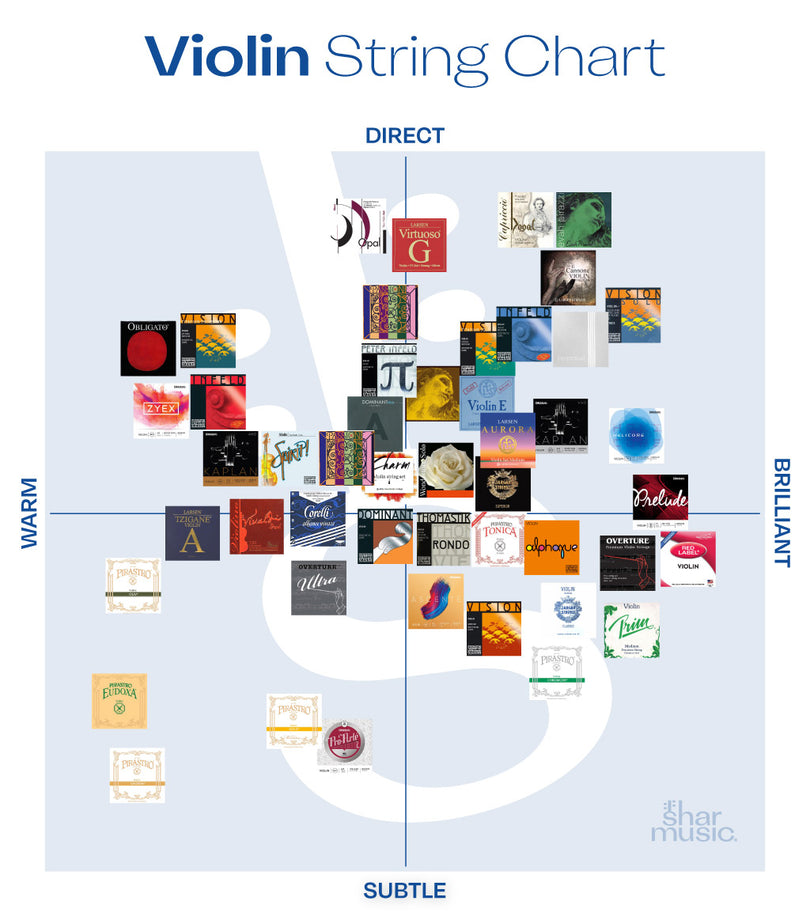
Now that you know your C, G, D and A strings, you're ready to choose the right replacements. Browse cello strings if you only need to replace one string, or shop complete cello string sets for a full refresh. Not sure which strings fit your tone goals? Our cello string chart places selected strings on warm-to-brilliant and subtle-to-direct tonal axes. Use it as a starting point, then check individual specifications and try recommendations suited to your cello.
Before you order, confirm your cello's size so your new strings fit properly. If you have questions, the Shar Music team is happy to help you find the right match.
FAQ
What are the four cello strings called?
The four cello strings are C, G, D and A, listed from lowest to highest. A is the 1st string and C is the 4th. A is normally the thinnest, while C is normally the thickest.
What notes are the cello strings tuned to?
The open strings are C2, G2, D3 and A3, a perfect fifth apart. With A4 = 440 Hz calibration, open A3 is 220 Hz and C2 is approximately 65.4 Hz in equal temperament. Do not tune the cello A string up to A4.
What is the difference between cello and violin strings?
The violin is tuned G, D, A, E, while the cello is tuned C, G, D, A, and much lower. The violin has a high E string that the cello doesn't, and the cello has a low C that the violin lacks. Strings are made for a specific instrument, so cello and violin strings aren't interchangeable.
How do I remember the cello string names?
Use "Cats Go Down Alleys" for C, G, D, A from low to high, or "A Darn Good Cello" for A, D, G, C from high to low.
Which cello string is the thickest and lowest?
The C string is the lowest and normally the thickest. It is the 4th string, tuned to C2, two octaves below middle C. It sits at the opposite edge of the fingerboard from the A string.
What is a 5-string or 6-string cello?
A common five-string tuning adds high E4 above A3. Six-string and other extended-range cellos use maker-specific tunings, so check the instrument specifications. Most beginner courses assume the standard four-string cello.
What are the different types of cello strings?
Cello strings use steel, synthetic or gut cores, and some sets combine constructions. Material affects feel and response, but it does not guarantee a particular tone. Check the core, size and tension of each product; gut is generally more sensitive to humidity.