

So, you’ve decided to learn a string instrument — what an exciting step! Playing a bowed string instrument like the violin, viola, cello, or double bass is an immensely rewarding experience, whether you’re aiming for a professional career or simply picking up music as a creative hobby.
Here at Shar Music®, our greatest expertise lies in the violin family — instruments with a rich history spanning centuries, from the halls of classical orchestras to the stages of jazz clubs, bluegrass festivals, and even modern hip-hop and R&B (just ask rising artists like Ezinma!). While classical music remains a wonderful foundation, these instruments open doors to countless styles and genres.
In this guide, we’ll walk you through the essentials of choosing your first violin, viola, cello, or bass — helping you weigh the options, find the right fit, and take the first steps on a journey that’s as inspiring as the music you’ll create.
1. Match the Instrument to Your Musical Personality
Your instrument isn’t just a tool — it’s your musical voice. The right choice depends on how you connect with its tone, role, and feel in different types of music. Here’s a guide to help you decide:
-
-
Personality fit: Energetic, adventurous, loves being in the spotlight.
-
Sound: Bright, brilliant, and versatile.
-
Ideal for: Soloists, classical music, folk, pop, or even modern crossovers like hip-hop and R&B.
-
-
-
Personality fit: Thoughtful, soulful, enjoys depth and nuance.
-
Sound: Warm, rich, and mellow — deeper than a violin but still agile.
-
Ideal for: Those who love harmonies, chamber music, and adding emotional depth to ensembles.
-
-
-
Personality fit: Balanced, expressive, and grounded.
-
Sound: Deep, resonant, and versatile — can soar like a singer or provide a solid bass line.
-
Ideal for: Players who want a rich, emotional sound that shines both solo and in an ensemble.
-
2. Start with the Right Size
An instrument that fits properly isn’t just more comfortable — it helps develop good technique and prevents strain. For violins and violas, measure from the neck to the center of the palm with the arm fully extended. Cellos and basses are sized by the hand span from index finger to pinky finger. When in doubt, size down slightly for easier handling. See our breakdown below.
For Violins:
-
Measure from the neck to the middle of the palm with the arm extended.
-
If between sizes, go slightly smaller for better comfort and technique development.

Have the student extend their arm straight out to their side, parallel to the floor, and in line with their shoulders. Next move their arm forward so that it is at a 45 degree angle (see video) to their shoulders.
Place a measuring tape at the base of the student's neck, next to their left collarbone, and measure out to the center of the student's palm.
If you are sizing for a violin, compare the measurement you have taken with this table:
| Neck to Palm Measurement | Instrument Size |
| 22" | 4/4 size |
| 21" | 3/4 size |
| 19.25" | 1/2 size |
| 17.25" | 1/4 size |
| 15.5" | 1/8 size |
| 14.75" | 1/10 size |
| 13.5" | 1/16 size |
| 13" | 1/32 size |
For Violas: (Same steps as Violin)
-
Measure from the neck to the middle of the palm with the arm extended.
-
If between sizes, go slightly smaller for better comfort and technique development.
Pick the measurement that either matches what you measured or is smaller than your measurement. Do not pick a measurement that is larger than what you measured for your student.
If you are sizing for a viola, use this table:
| Neck to Palm Measurement | Instrument Size |
| 26.25" | 16.5 inch |
| 25.5" | 16 inch |
| 24.5" | 15.5 inch |
| 23.75" | 15 inch |
| 22" | 14 inch |
| 21" | 13 inch |
| 19" | 12 inch |
| 17.25" | 11 inch |
For Cellos:
When sizing for a cello, we will be measuring the size of the student's left hand. Have the student extend their fingers similar to holding up the number five. Make sure the student is not over extending their fingers and that they are evenly spread. Take your measurement from the tip of the index finger to the tip of the pinky.

Once you have this measurement, match it up to the following table for cello:
By Finger Span
|
Cello Size |
Finger Span |
|
1/10 Cello |
6.35-7.62 cm or 2.5”-3” |
|
1/8 Cello |
7.62 cm or 3” |
|
1/4 Cello |
7.62-10.16 cm or 3”-4” |
|
1/2 Cello |
10.16-12.7 cm or 4”-5” |
|
3/4 Cello |
12.7-15.24 cm or 5”-6” |
|
4/4 Cello |
15.24+ cm or 6”+ |
For Basses:
Unlike violins or cellos, bass sizing is less standardized, which makes it harder to set strict rules for every player. The chart below provides a rough guideline based on height and age. Above all, the player should feel comfortable and able to play without strain.
For most adults, the standard size is ¾ — while 7/8 and 4/4 basses do exist, they’re far less common and often reserved for very tall or advanced players.
Checking the fit:
When standing upright with the bass:
-
The bridge should align roughly with the player’s right hand.
-
The fingerboard nut should sit near the player’s forehead, close to eye level.
-
The player should be able to reach the end of the fingerboard comfortably without overextending.
If you are sizing for a bass, use this table:
| Hand-Span (Index → Pinky) | Bass Size |
|---|---|
| ~3″ | 1/8 |
| ~3.5″ | 1/4 |
| ~4″ | 1/2 |
| ~4.5″ | 3/4 |
When in doubt, it’s best to size slightly smaller for ease of handling — and if you’re renting through Shar Replay®, upgrading as a student grows is quick and hassle-free.
3. Get a Complete Outfit
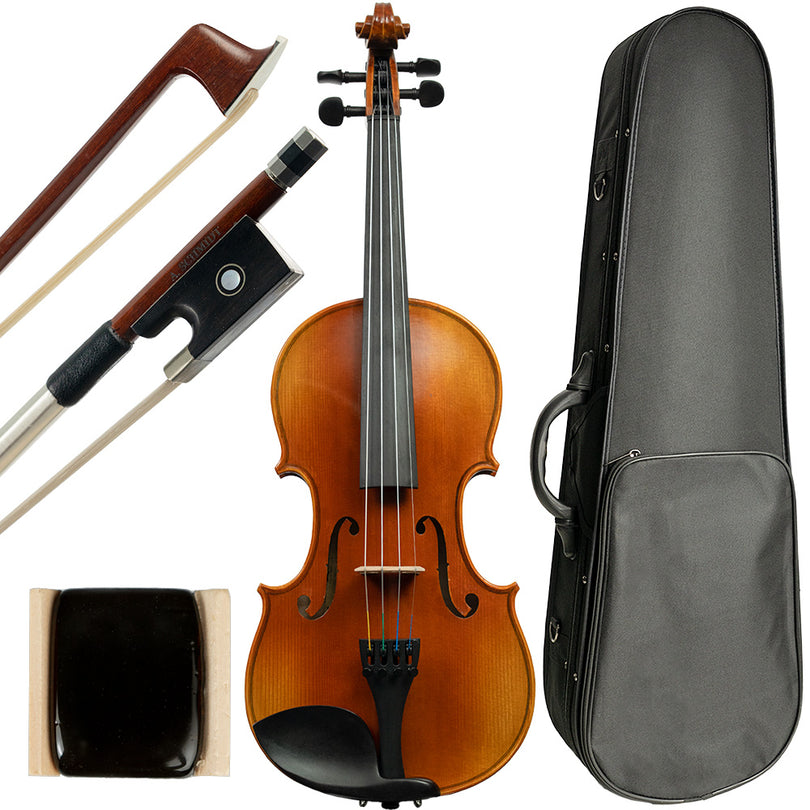
For first-time players, a student “outfit” — which includes the instrument, a bow, a case, and rosin — is the most convenient way to start. It ensures you have everything needed to play right away, without extra trips for accessories.
Our Franz Hoffmann line offers a range of beginner-friendly options:
-
Amadeus: Ideal for beginners. Easy to play with a bright tone.
-
Prelude: A step up in sound quality and craftsmanship.
-
Etude: Mid-range student instrument with richer tone.
-
Concert & Maestro: Advanced student levels, offering brighter and more complex tones for expressive playing.
Each comes as an instrument only or an outfit (with case, bow, and rosin)-perfect for beginners starting from scratch.
4. Try Before You Decide
The best way to find your perfect match? Play a few instruments first. Even at the beginner level, no two instruments feel exactly alike — you’ll notice differences in weight, responsiveness, and tone. If you’re new to playing, a teacher or experienced player can guide you in evaluating what feels and sounds best.
Not ready to commit?
That’s where Shar Replay®, our rent-to-own program, makes all the difference.
Why Shar Replay®?
-
Rent-to-own flexibility: Every payment builds equity toward ownership, making it easier to transition from renting to owning your dream instrument.
-
Free size upgrades: Perfect for growing students — trade up as needed at no extra cost.
-
Expert setup & maintenance: All instruments are professionally adjusted by our luthiers, with coverage for common maintenance needs.
-
Easy switching: If you decide a different size or even a different instrument is a better fit, Shar Replay makes it easy to switch.
5. Consider Construction & Materials
The sound and playability of an instrument depend heavily on its construction:
-
Wood: Look for solid spruce tops with maple ribs and backs for resonance and durability.
-
Seasoning: Well-seasoned wood prevents cracking and ensures stable tone over time.
-
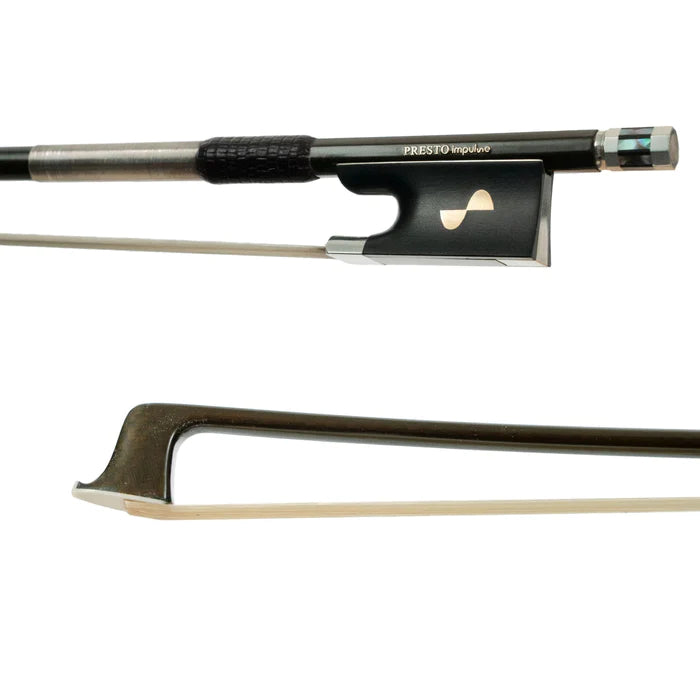
Bows: Choose between Brazilwood (affordable, beginner-friendly), iPe or Pernambuco (premium tone and responsiveness). For durability, carbon fiber is also an excellent option. For more information, view our bow vs bow article!
5. Ask for Guidance
Teachers, luthiers, or the Shar Music® team can provide personalized recommendations based on your goals, budget, and playing style. Comfort is critical for players of all experience levels. If an instrument is too big makes it harder to develop proper posture and bowing technique, while a well-fitted instrument encourages good habits and prevents strain. The team at Shar Music can help you choose an instrument that fits you best.
Final Thoughts
Choosing your first instrument is about more than cost or appearance-it's about finding the right partner for your musical journey. At Shar Music, our team of musicians are here to guide you every step of the way, ensuring your first experience with a bowed string instrument is nothing short of inspiring.
Ready to get started?
Explore our instruments or contact our team for personalized recommendations.