
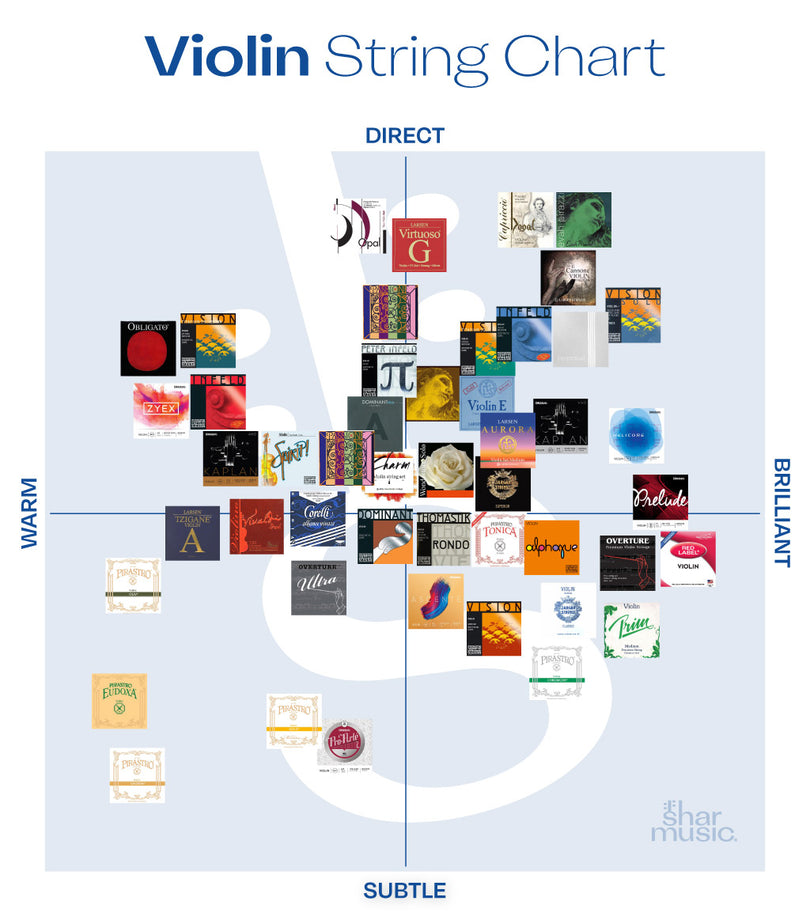


Of the four strings on the violin, the E-string is unique. With the exception of baroque violin E-strings, which are generally made from plain gut, the violin E-string is made from steel, giving it very different characteristics than the other three strings. And that's just the start. The type of steel, the alloys used, plating materials, and windings all contribute to the wide variety of E-strings available, so violinists can choose the one that best suits their instrument and their playing.
Many E-strings are plated with other metals, most commonly chrome and tin. Chrome offers a brilliant sound, while tin helps produce a warmer sound. Some strings are plated with precious metals, which enhance the sound and playing qualities of the underlying steel core and give players even more control over tone and response.
This guide describes, in general terms, the characteristics of platinum, titanium, and gold-plated E-strings.

PLATINUM
Platinum is a very dense metal that is easy to form (malleable) and non-reactive. This makes it ideal as a string coating, both to add mass and to protect the steel core from corrosion. It offers more warmth than plain steel, chrome steel, or aluminum-wound E-strings. Platinum-plated E-strings are known for their big, warm sound and rich overtones, and they are a favorite of many soloists.
Examples: Peter Infeld (PI) Platinum-plated E-String, Evah Pirazzi Platinum E-String, Dominant Pro Platinum-plated E-String
 TITANIUM
Titanium is very lightweight, yet extremely strong and hard. It has a shiny, smooth, lustrous finish that protects the steel core and offers a superb feel under the fingers. Like platinum, it is warmer than plain steel or aluminum-wound steel. Titanium adds power and clarity, making it ideal for players who want brilliance, especially in very high positions. Violinists often turn to a titanium E-string if they feel their violin isn't speaking clearly or if they want a faster response.
Examples: Opal Titan E-String, Vision Titanium E-String (Solo or Orchestra)
 GOLD
Gold is one of the heaviest plating materials, second only to platinum, and adds significant mass to the string. Because of its high cost, gold is used sparingly in string making, most often on E-strings. Gold is very soft and produces a warm, sweet, and powerful sound with plenty of overtones and an easy response. Many players use a gold-plated E-string to warm up a bright instrument.
Examples: Larsen Gold E-String, Obligato Goldsteel E-String, Evah Pirazzi Goldsteel E-String, Goldbrokat Premium 24 Carat Gold E-String, Peter Infeld (PI) Gold-plated E-String, Infeld Red E-String, Thomastik-Infeld Special Gold-plated E-String, Dominant Pro Gold-plated E-String
Thank you for reading! If you have more questions about E-strings contact our customer care team at 800-248-7427 or cc@sharmusic.com.