



A violin that's out of tune makes practice frustrating and makes it harder to train your ear. The good news is that tuning is a learnable skill, and it gets faster every time you do it. This guide walks you through the basic method, safe peg technique, tuning by ear, why a violin drifts out of tune, and a few next-level techniques for advancing players.
How to Tune a Violin: The Basic Method
The violin has four strings, each tuned a perfect fifth apart. From lowest to highest, they are G3, D4, A4, and E5. The G string is the thickest and sits on the far left as you look down at the violin in playing position. The E string is the thinnest and brightest, on the far right.
Most players tune the A string first. A is the standard reference pitch in Western music, it's the note an orchestra tunes to before every rehearsal, and it's the default note on nearly every tuner and tuning fork. Once your A is set, it becomes the anchor for the other three strings.
From there, choose one of two common orders:
- A, D, G, E: Work down from A to D, then G, and finish with E.
- A, E, D, G: Tune E right after A, then work down to D and G.
Either order works well. Pick one and use it every time so the routine becomes automatic.
You'll also need a reliable reference pitch. The most common sources are:
- An electronic tuner or app: The easiest option for beginners. A clip-on model like the Shar Neon Clip-On Tuner reads vibrations directly from the instrument, so it works even in a noisy room.
- A piano: Play the matching note and adjust the string until the two pitches sound the same.
- A tuning fork: Strike it, touch the base to a hard surface, and match your A string to the tone.
Once all four strings are done, go back and check the A one more time. Adjusting the other strings shifts the tension on the bridge slightly, which can nudge the first string out of tune.
Pegs vs. Fine Tuners: Safe Technique Without Snapping a String
Your violin has two tuning mechanisms. The wooden pegs in the pegbox handle large pitch changes, while the small metal fine tuners on the tailpiece handle tiny adjustments. If a string is only slightly off, use the fine tuner. If it's noticeably off, or the fine tuner is already turned all the way in, use the peg.
For pegs, the safest motion is to loosen first, then tighten while plucking, all while gently pushing the peg inward into the pegbox. There's a good reason for each part of this. Violin pegs have no gears; they're held in place purely by friction between the tapered peg and its tapered hole. Pushing inward as you turn increases that contact and friction, so the peg stays where you leave it instead of springing back. Loosening the string slightly before bringing it up to pitch lets it settle evenly, and approaching the note from below helps the peg seat firmly.
To avoid breaking a string, turn in small increments and pluck constantly so you always know where the pitch is. Before you turn anything, trace the string from the nut to its peg to make sure you're adjusting the right one. Tightening the wrong peg is the most common way beginners snap an E string.
Here's a detail many beginner guides skip: student violins usually come with fine tuners on all four strings, but professional instruments often have a fine tuner only on the E string, with the other three tuned entirely by the pegs. That's why peg control becomes more important as players advance. Fine tuners are a great starting point, but learning to use the pegs confidently is a skill worth building early.
Tuning by Ear and the Chromatic Tuner Trap Nobody Warns You About
Once your A string is set, you can tune the remaining strings by ear. Bow two adjacent strings together, such as A and D, and listen closely. When the interval is slightly off, you'll hear a pulsing "wah-wah" sound called beats. As you adjust the peg or fine tuner closer to the correct pitch, the pulsing slows down. When it disappears completely and the two strings ring together smoothly, you've reached a perfect fifth. Practicing this regularly builds relative pitch, which helps your intonation everywhere on the fingerboard, not just on open strings.
Electronic tuners are helpful, but there's a trap that most tuning guides never mention. A chromatic tuner identifies whatever note is closest to the pitch it hears. If a string has drifted badly, say a full half step flat, the tuner may read it as a different note entirely instead of showing that it's too low. For example, an A string that has dropped to A-flat may display as an in-tune G-sharp. A student sees the green light, assumes the string is correct, and keeps playing on a string tuned to the wrong pitch.
Two simple habits prevent this:
- Check the note name, not just the needle. Before you start adjusting, confirm the tuner shows the letter you're aiming for. If it doesn't, roughly figure out whether the string is above or below the target, then bring it into range.
- Use a violin or viola mode if your tuner has one. Many tuners include a mode that only listens for the four open-string pitches, so it can't mistake a badly flat string for a different note.
Why a Violin Won't Stay in Tune (and When It's a Repair, Not a Tuning Problem)
Some tuning drift is completely normal. New strings need time to stretch, so expect to retune them repeatedly over the first few days after installation. This settles down once the strings reach their stable tension.
Climate plays a big role too, because wood and strings respond to temperature and humidity. A few common scenarios across the US:
- The humid Southeast: Moist summer air causes wood to swell, which can make pegs tight and sticky and push pitch slightly higher.
- The dry Southwest: Low humidity shrinks the wood, so pegs can loosen and slip and strings tend to drop flat.
- Northern winters: Indoor heating dries the air dramatically, creating the same slipping-peg problem as the desert, often right after the furnace kicks on for the season.
A case humidifier and keeping the violin away from heating vents and sunny windows can help a lot.
There's a clear line, though, between normal drift and a repair issue. Needing a few more touch-ups than usual is expected. But if your pegs keep slipping even when you press them inward, if the bridge is visibly leaning or warped, or if the tone sounds muffled and choked in a way that suggests the soundpost has shifted, that's beyond everyday tuning. These problems can get worse over time, and a professional can usually fix them quickly. Shar Music's repair and restoration services are one option if you'd like an expert to take a look.
Leveling Up: Relative (Bowed) Tuning and Alternate Fiddle Tunings
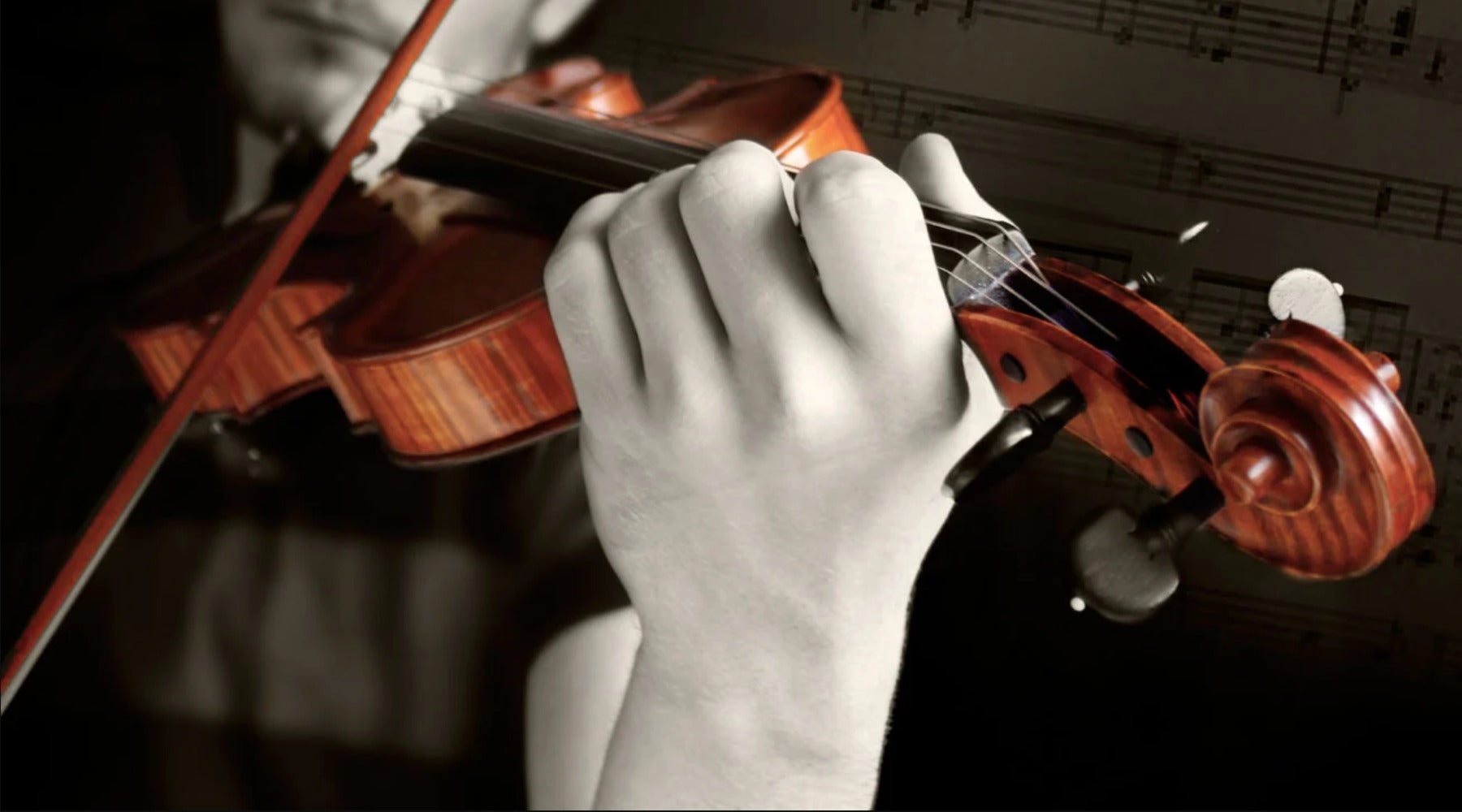
Once plucked tuning feels comfortable, the next step is bowed tuning, the method most professional and orchestral players use. Draw a long, steady bow across two strings at once with your right hand while your left hand adjusts the peg. Listen for the pulsing "wah" between the two strings and adjust until it disappears. Bowed tuning is more precise than plucking because the sound is sustained, giving your ear more time to hear the beats clearly. It does take coordination at first, so start with the A and D strings and work outward from there.
If you play fiddle music, you may also run into tunings other than standard G, D, A, E. Sawmill tuning (G, D, A, D) and cross or "open A" tuning (A, E, A, E) are popular in old-time and bluegrass music. These tunings let open strings ring as drones and make certain keys and tunes sound fuller. They're a deliberate stylistic choice, not a replacement for standard tuning, and they're best explored once you're comfortable with the basics. To learn more about how the two styles differ, see our guide on the difference between a fiddle and a violin.
Keep Your Violin in Tune for the Long Run
Tuning only becomes second nature through repetition, so going slowly and double-checking each string at first is completely normal, especially if you're new to pegs. Give yourself time, and it'll soon take less than a minute.
If you've tried everything above and your pegs still slip, the bridge looks warped, or the soundpost seems out of position, those aren't "practice more" problems. They're worth a one-time checkup at a professional shop such as Shar Music's repair and restoration services.
For everyday prevention, keep a tube of Hill Peg Compound in your case to help pegs turn smoothly and hold evenly, along with a reliable tuner like the Shar Chromatic Tuner. With a little care, your violin will stay in tune and ready to play.
FAQ
What are the four violin strings tuned to?
From lowest to highest, the strings are tuned to G3, D4, A4, and E5. Each string is a perfect fifth above the one below it.
How do I tune a violin without an electronic tuner?
Use a tuning fork or piano to set your A string, then tune the other strings by ear. Bow two adjacent strings together and adjust until the pulsing "wah" sound disappears, which means you've reached a perfect fifth.
Can I tune a violin using a piano?
Yes. Play the A above middle C and match your A string to it, then use the piano's G below middle C, D just above middle C, and E an octave above the E just above middle C for the other strings. A piano is only a good reference if it's been tuned recently.
Why does my tuner say I'm in tune when the string still sounds wrong?
Chromatic tuners show the nearest note, so a badly out-of-tune string may register as a different note entirely. Check that the note name on the display matches the string you're tuning, or switch to a violin mode if your tuner has one.
How do I tune a violin without breaking a string?
Turn pegs in small increments while plucking, so you always hear where the pitch is. Confirm which peg belongs to which string before turning, and use fine tuners for small adjustments.
Why do my pegs keep slipping right after I tune them?
Pegs are held by friction, so press them inward as you turn. Dry air from heating or desert climates can also shrink the wood and cause slipping. If pegs still slip with inward pressure and peg compound, have a repair shop check the fit.
Is A440 or A442 correct for tuning a violin?
Both are used. A440 is the most common standard in the US and is the right choice for most students. Many European orchestras and some American ensembles tune slightly higher, around A442, so follow your teacher's or ensemble's preference.