
This article was originally published on Violinist.com by Laurie Niles and is reposted here with permission. You can view the original article here: https://www.violinist.com/blog/laurie/20264/30727/
A teacher understands why a quality instrument makes a huge difference for a student, but a parent or new student may not know what a "quality instrument" means, or why it's important. A student's success depends, in large part, on making the case playing for a good-quality instrument.
So what is that case, and how do you make it?
This was the topic of a lecture called "Communicating Instrument Quality to Families" by Jordan Nichols at the American String Teachers Association/Suzuki Association of the Americas Conference in February in San Francisco.
Nichols is Director of Sales for Shar Music, which offers violins, violas, cellos and basses at a wide range of price points (from $189 to $42,000 for violins, for example). I wondered, what are the make-or-break features that a violin needs to have, at any price-point, to pass the playability test and be of "decent quality"?
As a longtime teacher myself, I know that a new student or parent quite rightly will ask the question: Why should I spend money on a quality instrument for a mere beginner? Or even for an intermediate or semi-advanced student?
In a nutshell, a good-quality instrument will support a student's efforts, while a poor-quality instrument will cause a student to struggle. "When a student is struggling with an instrument, they sometimes respond internally, thinking they are not good enough," Nichols said.
It's important to know that a "good-quality" can still be economical. There is a whole continuum of instruments, from relatively inexpensive student violins, to somewhat more expensive intermediate violins, to very expensive soloist-quality concert violins - with a lot in between. A long-term student likely will go through a number of violins as they grow both physically and artistically.
At every stage it is possible to find a playable instrument that sounds good and functions well, but, especially in the beginning, teachers need to help their students and their families identify the good from the bad. That's another skill that teachers can help their students cultivate over the years: the ability to identify a quality instrument.
It's important not to fall into a trap of false economy, saving money up front but ending up with an instrument that serves poorly and requires constant repair.
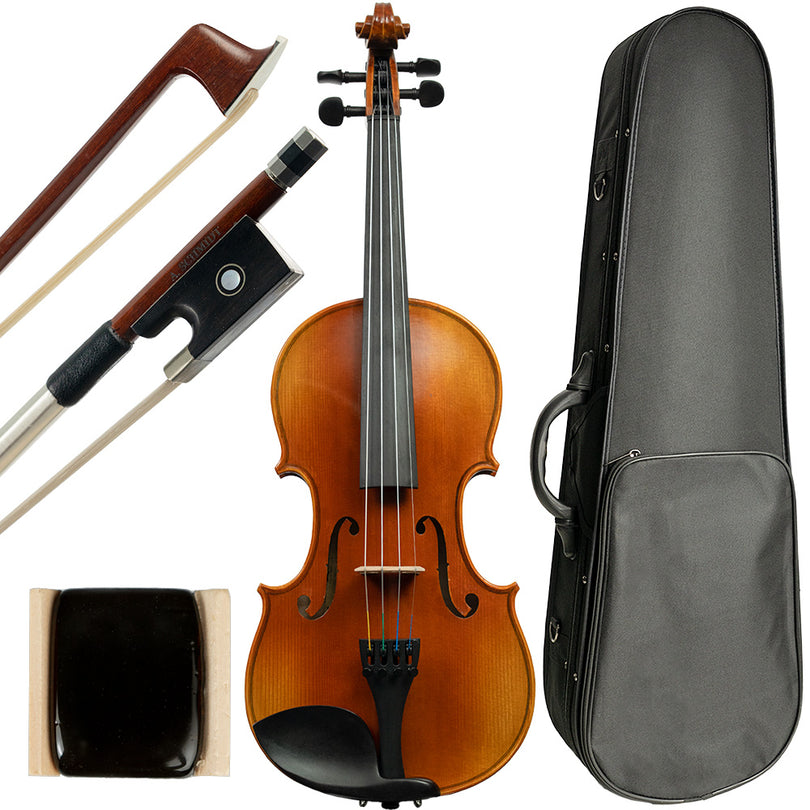
The trouble is there are no easy-to-read labels on a violin that tell a "good" instrument from a "bad" one. If you put a good quality violin next to a bad one, the two instruments might look pretty similar. Beware the Violin-Shaped-Object, or "VSO." It looks like a violin but certainly doesn't act like one!
Certain specific details of construction - from materials to craftsmanship - can give you clues about quality. Each one of these details adds up when it comes to the playability of the violin. That is why it is important for those with limited musical experience to agree to work with a teacher to decide when it is time to upgrade and what the appropriate next instrument might be.
One determining factor is the wood. A violin should be made from properly age tonewood - that is, wood that has been air-dried for five to 10 years or more. This kind of wood is stable, lightweight and resonant. However, to cut costs, cheaper instruments often use "green" wood, which is unseasoned and has a higher moisture content.
"This leads to a heavier instrument with dampened vibrations," Nichols said. The tonal quality of the instrument is not as bright, and it is also more prone to warping.
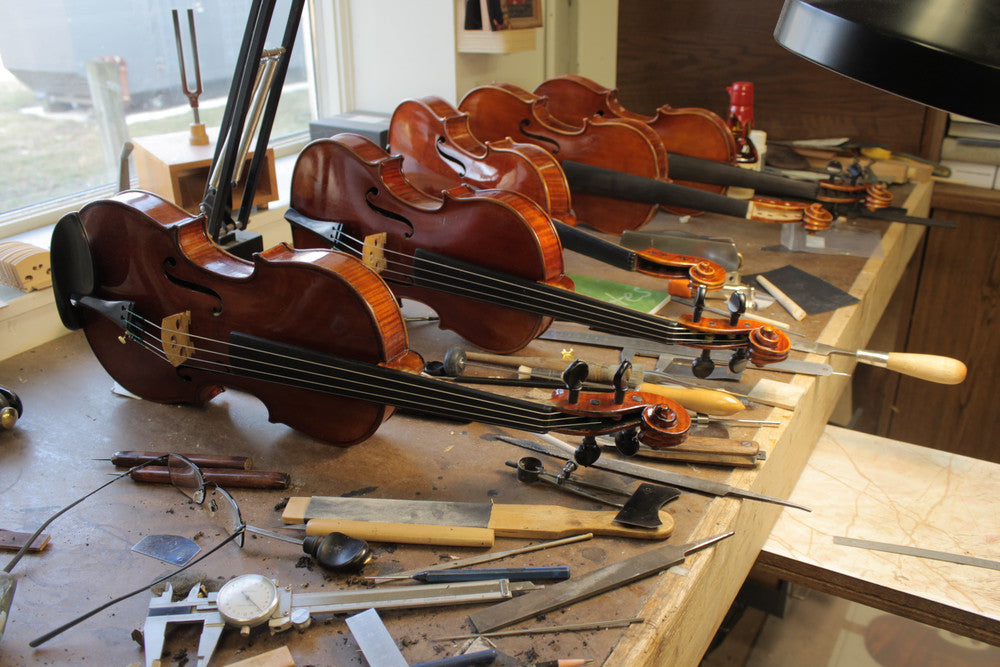
Another major factor is the craftsmanship. Violins can be "factory made" - manufactured - or they can be handmade by a luthier.
"Not all manufactured instruments are bad," Nichols said. It depends greatly on quality control. For example, CNC (Computer Numerical Control) machines can cut wood into templates, but without quality control you can have inconsistent wood with identical cuts.
On the other hand, a luthier hand-picks wood by tap tone. "It really is an art," Nichols said. "They have hand selected each piece of the instrument and then hand-graduated it for resonance."
The "set-up" is something that is possible to see with your own eyes, though the details can be subtle and you have to know what you are looking for. The "set-up" has to do with details such as the pegs, the bridge, the nut and the height of the strings, and these things are important for the proper functioning of the violin. Potential problems with a cheap violin. Illustration by Shar Music
The pegs are used to tune the violin, and "you don't want it to be a battle to tune the instrument," Nichols said. Ill-fitting pegs will slip out of tune easily, or get so stuck that you can barely move the pegs. This causes tuning the violin to be a time-consuming battle of frustration - and tuning is something you do every time you get out the instrument! A student may even give up and leave the violin out-of-tune, which is bad for the development of good pitch. If the pegs stick or slip too much - this is a sign of ill-fitting pegs.
The bridge holds up the strings of the violin and also transmits sound vibrations from the string into the body of the violin. To function properly, the feet of the bridge should fit neatly onto the body of the violin. "Every bridge should be hand-carved," Nichols said. If the bridge is not fitted to the violin, then the vibrations are not properly transmitted, resulting in a deadened tone.
The nut, which holds up the strings next to the scroll, can also cause problems if it is too high (making the strings too high) or if the grooves are poorly filed and have sharp edges - this can actually cause strings to break! If the grooves are too deep then it can cause a buzzing sound, as as the strings vibrate against the side of the grooves in the nut.
And, the general height of the strings can be an issue. If the strings are too far from the fingerboard, then the student has to press very hard to stop the strings, causing finger tension, fatigue and even pain.
Many students will start with a standard student instrument, and "that is part of the journey," Nichols said, but do take care that it's not a "VSO." The basic student violin can be functional for beginners, but limited. "It's good for starting, but not for soaring," Nichols said. "Better materials and skilled craftsmanship will still equal better sound."
A resistant tool causes tension and frustration, it stalls technique and it eats away at a student's confidence.
On the other hand, your instrument can be one of your teachers. A good instrument allows the focus to shift to music as the student learns to trust that the instrument will respond to efforts at good intonation, tone production, vibrato, dynamics, playing in the highest range, etc.
"If they love the instrument, they will want to continue to play with it," Nichols said.
How can a teacher or student approach a reticent parent about upgrading their instrument?
The teacher can let a student know when the instrument is truly holding them back, and frame it in a positive light. "It's not you, it's the instrument. You have outgrown this instrument, congratulations!"
"Outgrowing" an instrument is a sign of progress - that a student is ready for more advanced techniques.
It's important to be specific and to name exactly what the problem is with the instrument, such as:
- slow response
- high notes that are choking despite correct technique
- very limited dynamic range despite correct efforts to play forte or piano
- a lack of core sound that causes the sound to "disappear" during performance
It can help to have the student actually play on an upgraded instrument for a while, to see how it compares with their current instrument. Many violin shops (Shar included) will offer a trial period for a new instrument. "If the student buys in, they will advocate for getting the upgraded instrument," Nichols said.
A parent (or adult student) will be more responsive if they have some advance notice about possibly needing an upgrade. Also, it's easier to upgrade if they start from the beginning with a rental or buying program that allow them to rent-to-own and/or has a trade-in policy. (Nichols mentioned that Shar has a trade-in policy as well as an option to rent-to-own.) This way the student/parent is always building equity toward the next upgrade.
When a parent argues that a new instrument is expensive, this is a real concern. But having a quality tool also protects the investment that a parent has made in tuition. A better instrument is actually the best insurance policy against quitting, and it allows a student's growth to happen faster.
Another argument is: "We'll upgrade when they get better." At a certain point the tool precedes the progress - they can't get better because the instrument is holding them back.
And yes, it can get so frustrating that they want to quit. Trying to play when also contending with impossible pegs and a constantly out-of-tune and bad-sounding instrument - this can be a deal-breaker!
The best thing to do is to gather as much information as possible, to get the best-quality instrument for your price range, and also to position your student (or self) to be able to upgrade if and when the time is right.
© Laurie Niles / Violinist.com. Reposted with permission.