
A familiar holiday tune is one of the best motivators a new violinist can have. Carols are short, everyone recognizes them, and a student can often be ready to play one for family or a studio recital with enough preparation time. Success depends on choosing music that fits the skills a player already has. In this guide, we cover how to spot a beginner-friendly arrangement, which songs to try first, how to practice them efficiently, and how to prepare for a first holiday performance.
What Makes a Christmas Violin Arrangement Beginner-Friendly?
An easy arrangement is one that uses skills the student already has. Look for a few observable features instead of relying on the word "easy" in the title.
- Comfortable range. Most early arrangements stay in first position, often on the D and A strings, with no notes beyond the reach of the fourth finger.
- Familiar finger patterns. Many beginner books start with the pattern where the second and third fingers sit close together, which is used on the D and A strings in D major. A key that requires a new pattern adds a layer of difficulty.
- Manageable rhythms. Quarter notes, half notes, and simple pairs of eighth notes are easier to read and count than dotted rhythms, ties, or syncopation.
- Bowing the student has learned. Separate bows and simple two-note slurs are realistic. Hooked bows, long slurs, and fast string crossings belong a little later.
The label "beginner" varies between publishers. One company's level 1 may be another's level 2, and a simplified carol can still include an awkward shift or a tricky rhythm. Before choosing a book, compare a sample page with the student's current lesson material. If the notes, rhythms, and bowings look like what they are already playing, the arrangement is likely a good fit.
Start with Jingle Bells, Jolly Old Saint Nicholas, and Silent Night
For a first holiday piece, we suggest a short list of four carols: Jingle Bells, Jolly Old Saint Nicholas, Silent Night, and Away in a Manger. Each one appears in many beginner collections, and each teaches something slightly different. The table below highlights features to inspect in a beginner edition. Keys, rhythms, phrase lengths, and string crossings vary by arrangement.
| Song | What to check in the notes | Rhythm and phrasing | Bowing check |
|---|---|---|---|
| Jolly Old Saint Nicholas | Repeated notes and any unfamiliar finger patterns | Count held notes in the chosen edition | Locate each string change |
| Jingle Bells | Key, refrain range, and any larger leaps | Repeated-note rhythm; the verse may be busier | Check which strings the arrangement uses |
| Away in a Manger | Which melody is used and its range | Check the meter and whether there is a pickup | Plan bow use around the printed phrases |
| Silent Night | Leaps, range, and required finger patterns | Dotted rhythms and sustained phrases | Save enough bow for long notes |
Away in a Manger is sung to different melodies depending on region and tradition, so ask your teacher which version to learn before buying a book.
A first-position arrangement can still be challenging. A beginner edition of Silent Night may stay in first position, but its long phrases still require planned bow use. Jingle Bells looks simple, yet repeated notes and any string crossings can make the bow arm tense. Pick one tune, learn it from beginning to end, and play it comfortably before adding a second song. One finished carol is more rewarding than four half-learned ones.
Learn the Notes and Rhythm Before Adding Speed
Speed is the last thing to add. A simple practice sequence keeps a new carol from turning into a string of guessed notes.
- Listen first. Play a reliable recording of the same arrangement, or one in the same key, a few times while following the music.
- Clap and count the rhythm. Clap each measure while counting the beats aloud, without the violin. This step catches held notes and rests that are easy to rush.
- Locate unfamiliar notes. Circle any note or finger the student has not played before and find it slowly on the instrument.
- Practice short phrases slowly. Work on one or two measures at a time at a tempo where every note is in tune, then connect the phrases.
Many beginners learn from finger-number tablature, which shows the string letter and the finger to use. It is a helpful shortcut, but it often leaves the rhythm incomplete. Here is a short pitch guide to the opening of the Jingle Bells chorus in D major:
D2 D2 D2 | D2 D2 D2 | D2 A0 D0 D1 | D2
D2 means a high second finger on the D string (F♯); A0 is the open A string, D0 is open D, and D1 is E on the D string. This short guide does not show complete rhythm or a complete phrase. In the first two groups, the third note is held longer than the first two. Pair finger numbers with standard notation and a trustworthy recording so both pitch and rhythm come out right.
Make Simple Carols Sound Musical
Once the notes are secure, a few basic habits will make even the simplest carol sound polished.
- Plan bow distribution. Use more bow for long notes and less for short ones. In Silent Night, avoid spending too much bow at the start of a held note so it lasts to the end.
- Keep a steady pulse. Practice with a metronome at a slow setting. Many students slow down at hard spots and speed up on easy ones, and an even beat smooths that out.
- Finish each phrase. Let the last note of a phrase ring for its full value, then shape the next phrase like a singer taking a breath, without adding extra beats unless the score or agreed interpretation calls for them.
- Relax string crossings. Move the whole arm slightly to reach the next string, keeping the elbow at the level of the string being played rather than reaching with the wrist alone.
When one phrase keeps falling apart, isolate the two or three notes where it goes wrong. Play them slowly until they feel easy, then add one note before and one note after. Gradually widen the section until it reconnects with the full phrase, and then play the phrase in context at the same slow tempo.
Skip vibrato, trills, and added ornaments for now. A clean, in-tune carol with a clear beginning and ending sounds far better than an ambitious version that falls apart.
Prepare for a First Holiday Performance
A performance feels very different from practice, so rehearse the moments that tend to make players nervous.
- Starts. Practice placing the bow, taking a breath, and beginning on the first note several times in a row.
- Endings. Hold the final note for its full length and keep the bow on the string for a moment before lifting.
- Recovery. During run-throughs, keep going after a mistake instead of stopping. Choose a few places to rejoin, such as the start of each phrase.
When playing with piano or a backing track, check whether the accompaniment begins with an introduction. Count those measures of rest aloud in rehearsal so the entrance feels confident. If a recorded track is too fast, choose a slower version suited to students rather than rushing to keep up. A comfortable tempo always sounds better than a hurried one.
Before the performance, use this readiness checklist:
- The full carol can be played from start to finish without stopping.
- The music is secure on the stand, with any page turns planned or removed.
- The tempo feels comfortable, even with a little nervous energy.
- Starts, endings, and entrances have been practiced with the accompaniment.
Find Holiday Music for Your Level
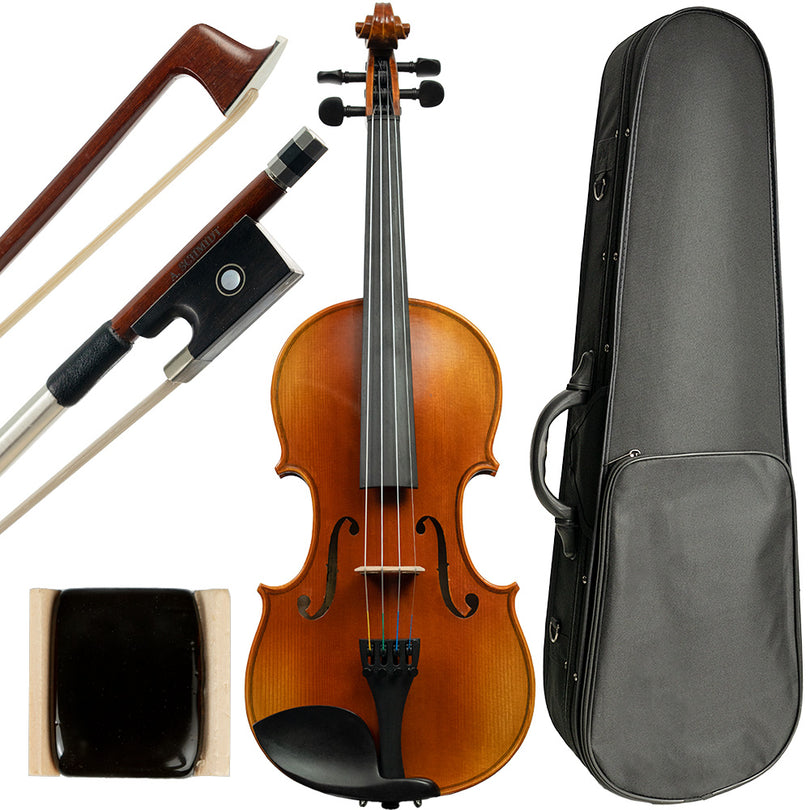
When it is time to choose an edition, browse the Shar Music holiday music collection for Christmas and seasonal books at a range of levels. We recommend asking a teacher to look over the arrangement before purchase so it matches the student's current skills. If the player still needs an instrument, our selection of beginning violins, including Franz Hoffmann® outfits, is a good next step. With the right music and a well-adjusted violin, a first holiday performance is well within reach.
FAQ
Which Christmas violin song should I learn first?
Jolly Old Saint Nicholas or Jingle Bells is a good first choice for most beginners. Both use short phrases, simple rhythms, and familiar finger patterns. Silent Night works well as a second piece once longer bows feel comfortable. Choose the one your teacher recommends and you enjoy most.
Can a beginner play Christmas songs in first position?
Yes. Many carols are arranged entirely in first position. Even so, check for new finger patterns, dotted rhythms, or long slurs, since these can make a first-position arrangement harder than it looks.
How can I tell whether a Christmas arrangement is too difficult?
Compare a sample page with your current lesson material. If more than a few notes, rhythms, or bowings are unfamiliar, the arrangement is probably a level too high. A teacher can confirm the fit before you buy.
Can finger numbers help me learn a Christmas song?
Finger numbers can help you find the right string and finger quickly. They usually do not show rhythm, so use them alongside standard notation and a reliable recording. Over time, aim to rely more on the notation itself.
Should I practice with a backing track from the beginning?
Not usually. Learn the notes and rhythm on your own first, at a slow tempo. Add the backing track once you can play the piece steadily, and practice counting any introduction before you enter.
What should I do if I cannot play a carol at the recorded tempo?
Practice at a slower tempo with a metronome and raise it a little at a time. For a performance, choose a slower accompaniment track or ask your accompanist to adjust the tempo instead of rushing.