
Violin String Sound Chart
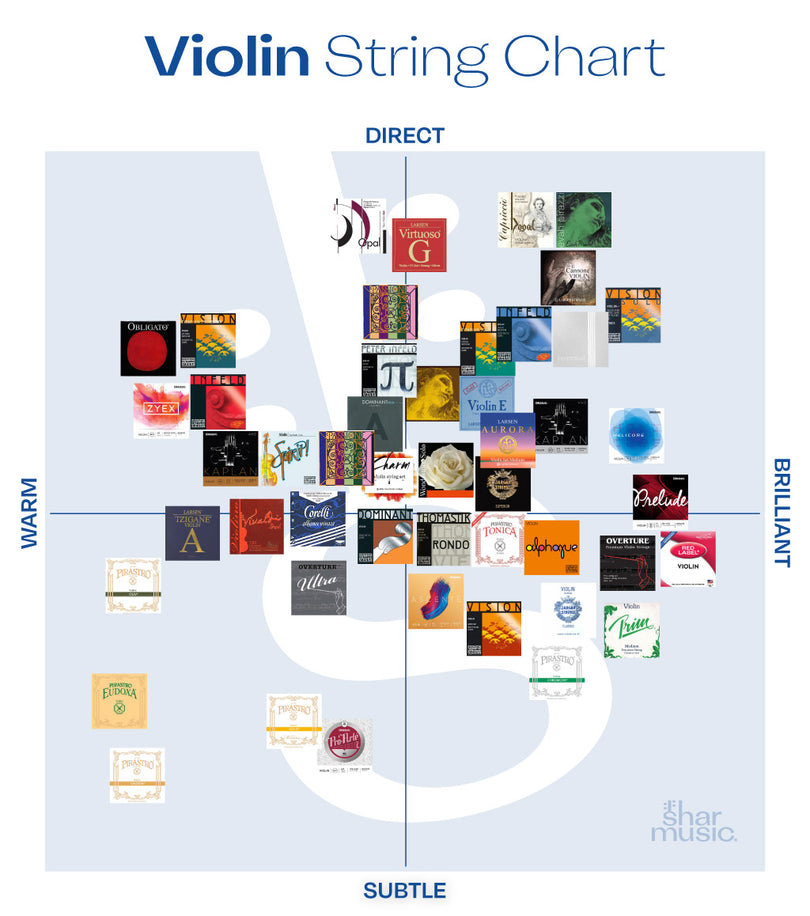
What violin strings are right for you? Our violin string sound chart maps the most popular sets by tone and character, so you can find the right match before you spend money on a set that isn't for you.

How to Read This Chart
Shar Music carries an extensive range of violin strings from all of your favorite brands. Whether you're a beginner looking for high-response steel strings or a professional who needs that classic, subtle gut sound, there's something here for you.
- Top to bottom: strings near the top are more direct and soloistic; strings near the bottom lean more subtle.
- Left to right: strings to the left have a warmer sound; moving right gives you more brilliance.
Which Violin Strings Should You Choose?
Beginners
If you're still getting the hang of pulling a good sound from your instrument, your best bet is the middle-right area of the chart, nearest to "brilliant." That's where you'll find Red Label, Overture, and other excellent beginner sets. These respond easily and hold their tuning while you're still building bow control.
Intermediate and Group Players
Many intermediate players — especially those playing in an orchestra or ensemble — do well closer to the center of the chart, where you'll find Thomastik Dominant and Corelli Alliance Vivace. These blend well in a section without disappearing.
Advanced and Soloists
Advanced players are usually drawn toward the top of the chart, home to celebrated sets like Larsen Il Cannone and Pirastro Evah Pirazzi. These project strongly and give you the most control over color.
Violin String Comparison
| String Set | Character | Tone | Best For |
|---|---|---|---|
| Super-Sensitive Red Label | Subtle | Brilliant | Beginner |
| Overture | Subtle | Brilliant | Beginner |
| Thomastik Dominant | Balanced | Balanced | Intermediate, ensemble |
| Corelli Alliance Vivace | Balanced | Balanced | Intermediate, ensemble |
| Pirastro Evah Pirazzi | Direct, soloistic | Brilliant | Advanced, soloist |
| Larsen Il Cannone | Direct, soloistic | Warm | Advanced, soloist |
Frequently Asked Questions
How often should I change my violin strings?
For a student practicing daily, every 6 to 12 months. Advanced players and professionals often change every 3 to 6 months, or sooner before a performance. Change them when the sound goes dull, the strings stop holding pitch, or you can see wear where the bow contacts them.
What's the difference between synthetic core and steel core strings?
Steel core strings settle in tune quickly, stay stable through temperature changes, and are more durable — which is why they suit beginners. Synthetic core strings produce a warmer, more complex sound but drift out of tune more when new. Gut core strings offer the richest color and the least stability, and are generally for advanced players.
Which violin strings do teachers usually recommend for students?
Thomastik Dominant is the most commonly recommended step-up set for students moving past their first year. For true beginners, most teachers stay with the steel sets that come on a student outfit until bow control develops.
Will higher-tension strings make my violin louder?
Not necessarily. Higher tension can add projection on some instruments, but on others it chokes the response and makes the violin harder to play. Tension interacts with your specific instrument — it's worth trying a medium set first.
Can I mix string brands on one violin?
Yes, and many advanced players do — a common combination is a different E string paired with a full set of something else. Just be aware that mixing tensions can unbalance the response across strings.
How long do new violin strings take to settle?
Synthetic core strings usually take 3 to 7 days of regular playing before they hold pitch reliably. Steel strings settle within a day. Expect to retune frequently during that window — it's normal, not a defect.
Need Help Choosing?
Someone on our staff is always happy to help you find the right strings. Call us at 1-800-248-7427 or email cc@sharmusic.com.
More String Resources
Violin String Sound Chart | Viola String Sound Chart | Cello String Sound Chart | Instrument Size Charts | Instrument Rentals